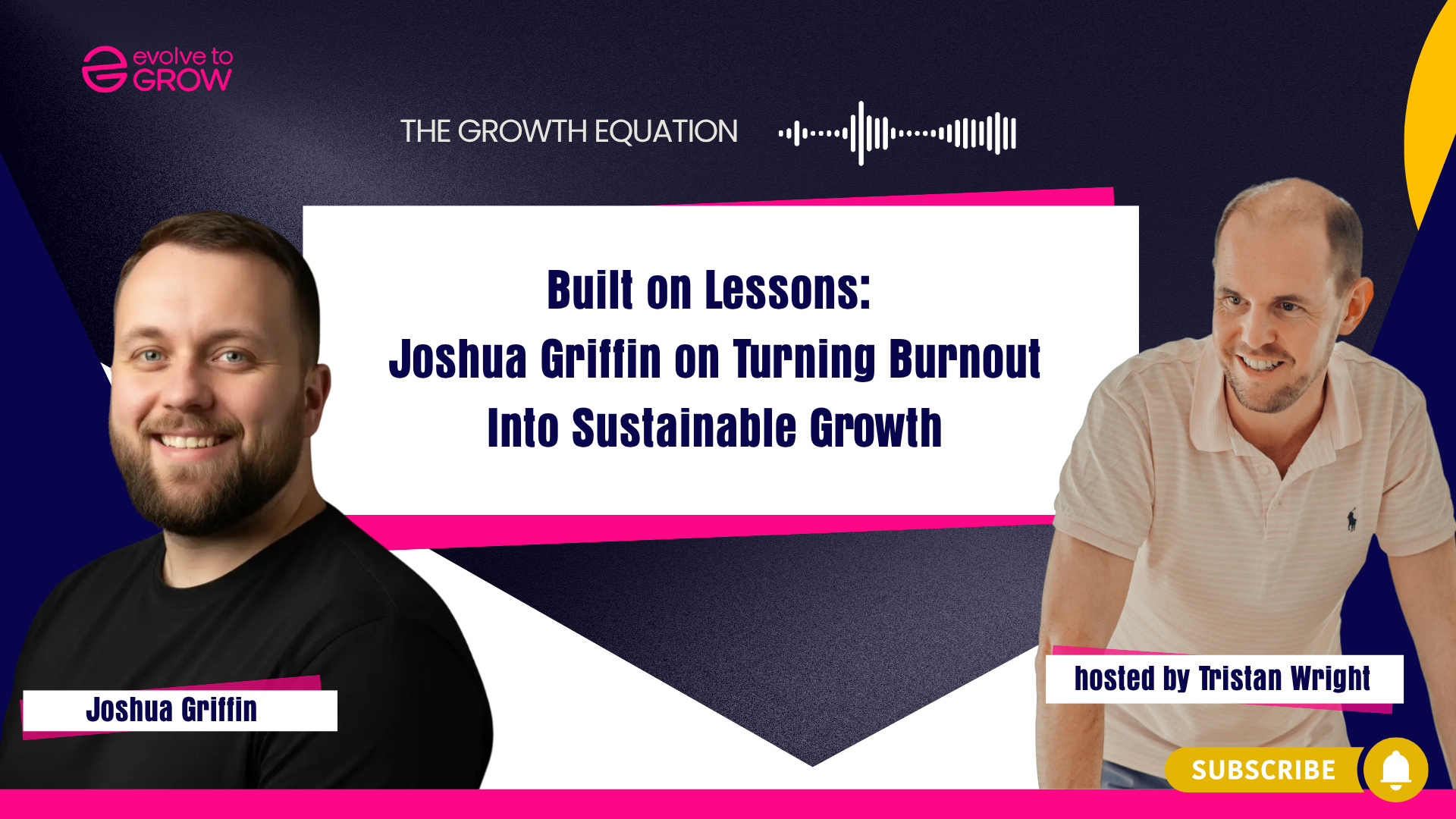
Turning Burnout Into Sustainable Growth: Lessons From Entrepreneur Joshua Griffin
When Building a Business Starts Costing You Too Much
Entrepreneurship is often presented as a path to freedom. You start a business, take control of your time, and build something of your own.
But the reality can look very different.
For some founders, business growth brings longer hours, greater financial pressure, and more responsibility. Instead of gaining freedom, they become the person responsible for every decision, every customer issue, and every operational problem.
Joshua Griffin, co-founder of Intrinzi, experienced this firsthand.
His entrepreneurial journey began in e-commerce, where he taught himself marketing, experimented with print-on-demand, and gradually grew his business from a small bedroom operation into a warehouse-based operation.
But as the business expanded, so did the workload. Joshua was handling everything from marketing and sales to packing orders, customer service, and fulfilment. When rising costs and changing economic conditions put further pressure on the business, he took on delivery work to help cover expenses.
Eventually, he was working 16-hour days, six days a week.
The business had become so dependent on him that it couldn’t grow without demanding even more of his time.
In this episode of The Growth Equation, Joshua joins Tristan Wright to reflect on that experience, the toll it took, and how he used those lessons to build a different kind of business.
His story offers an important reminder: sustainable growth isn’t just about how much a business can generate. It’s also about whether the business can operate without exhausting the person running it.
The Hidden Cost of Being the Entire Business
Joshua’s first business grew through experimentation and persistence. He started with print-on-demand products, learned digital marketing as he went, and began importing products to improve his margins.
During the pandemic, paid advertising became an important growth driver. He expanded his product range, moved into larger premises, and began attending physical events where he saw promising sales.
Encouraged by that momentum, he forecasted further growth and invested in more stock.
But when the cost of living increased and consumer spending came under pressure, the business faced a different reality. Joshua had around £35,000 in personal debt, and he was struggling to balance the costs of running the business.
He was doing more work just to keep things going.
He packed orders, handled customer service, managed the warehouse, and took on delivery shifts. The business depended on his constant involvement, leaving little room to work on growth or improve the operation.
This is one of the risks of founder dependency.
When the founder is responsible for every critical function, the business has a ceiling. The founder’s time, energy, and capacity become the limits of the company’s ability to operate.
Even if demand exists, the business may not be able to serve it profitably or consistently.
Joshua’s experience shows why entrepreneurs need to look beyond revenue and ask whether their operating model is sustainable.
Recognising Burnout and Making a Difficult Decision
The pressure eventually began affecting Joshua’s health.
He describes working long hours, staying constantly connected to his phone, and finding it difficult to switch off—even when he was meant to be away from work.
After physically collapsing one evening, he sought medical help. A conversation with his doctor made him reconsider the pace and demands of his life.
He realised that something had to change.
Letting go of the business was difficult. He had built it from nothing, invested time and money into it, and watched it grow. But it had become too reliant on him, and continuing in the same way was not sustainable.
Walking away became a turning point.
For entrepreneurs, stepping away from a business can feel like admitting defeat. But Joshua’s story highlights a more nuanced reality: sometimes the most important business decision is recognising that the current model isn’t working.
The experience gave him a clearer understanding of what he wanted to do differently in the future.
It also showed him the importance of building a business that doesn’t depend entirely on the founder’s ability to keep pushing.
Starting Again With the Right Business Partner
After leaving his first business, Joshua returned to the industry and worked in marketing alongside Dan, who would later become his co-founder.
The two had complementary experience. Joshua brought marketing knowledge, while Dan had strong e-commerce and technical expertise.
After helping grow a business that was eventually acquired, they found themselves considering what to do next.
Rather than continuing to build someone else’s company, they decided to start a business together.
They initially focused on software and services that could generate monthly recurring revenue. Their goal was to create a model that was less operationally demanding than e-commerce and offered more predictable income.
Their business, Intrinzi, evolved over time. They began with software and automation-related services, then expanded into a full-stack agency offering bespoke web design, development, SEO, paid advertising, and automation.
The important difference was not just the services they offered. It was how they approached the business itself.
This time, Joshua wasn’t trying to do everything alone.
He and Dan found their respective roles: Joshua focused on scaling, marketing, and sales, while Dan concentrated on building and delivery.
Having someone to share the responsibility with helped make the work more manageable and the business less dependent on one person’s capacity.
A co-founder isn’t the only way to create that support. A trusted mentor, business coach, or experienced peer can also help entrepreneurs navigate difficult decisions and reduce the isolation that often comes with running a business.
Use Data to Make Better Business Decisions
One of the biggest lessons Joshua carried into Intrinzi was the importance of tracking business performance.
In his first business, he had focused heavily on getting orders out and keeping the operation running. In his new venture, he became much more deliberate about capturing data across the business.
That included tracking:
- Sales conversations and outreach
- Conversion rates
- Customer interactions
- Churn
- Retention
- Recurring revenue
Tracking these indicators gave Joshua a clearer picture of what was happening and where the business needed to adapt.
For example, by noticing patterns that suggested some clients might be at risk of leaving, he and Dan could contact them earlier, clarify expectations, and provide the right support and documentation.
Rather than waiting for a customer to become dissatisfied or cancel a service, they could respond to early signals.
This is where data becomes more than a reporting tool. It becomes a way to make better decisions before problems grow.
For small businesses, tracking every possible metric can quickly become overwhelming. The objective isn’t to collect data for its own sake. It’s to identify the numbers that help you understand your customers, profitability, and capacity.
The right metrics should help answer practical questions:
- Are our sales activities converting?
- Are customers staying with us?
- Where are clients experiencing friction?
- Which services are profitable?
- Can we deliver the work with the capacity we have?
When the numbers inform action, business owners can adapt their model based on evidence rather than instinct alone.
Pivoting Towards a More Sustainable Business Model
Intrinzi didn’t remain fixed to its original offer.
As Joshua and Dan learned more about the market, they adjusted their services and refined their positioning. They saw opportunities to provide more comprehensive solutions to businesses, particularly trades and service companies that needed websites, marketing, and automation.
They also recognised that the market was crowded with agencies making promises that didn’t always match what they delivered.
Joshua chose to be transparent with clients about what marketing could realistically achieve, rather than guaranteeing immediate results.
Over time, Intrinzi moved away from a lower-cost, volume-focused approach and towards more bespoke services and higher-value client relationships.
That shift changed the way the business operated.
They could spend more time understanding clients, offer more tailored work, and build recurring revenue through ongoing services.
Joshua also began visiting clients in person, investing time in relationships beyond the initial sale. These meetings helped build trust and gave clients more direct access to the people responsible for their work.
The lesson is that a business model should evolve as the founder learns more about the market.
A pivot doesn’t necessarily mean abandoning everything you’ve built. It can mean adjusting the offer, pricing, delivery model, or target customer to create a better fit between what clients need and what the business can deliver.
Build Systems Before You Need to Scale
Joshua’s first business relied heavily on what he personally knew and could do. He hadn’t developed the standard operating procedures needed to make key tasks repeatable.
With Intrinzi, he and Dan have taken a more structured approach.
They’re documenting processes, creating SOPs, and establishing clearer procedures for everything from proposals to client offboarding.
This serves two purposes.
First, it makes the current business more consistent. When tasks follow a defined process, fewer things rely on memory or individual habits.
Second, it creates a foundation for future growth. If the business brings in additional team members, those people will have clearer guidance on how work should be done.
Systems are especially important for small teams because each person often carries a significant amount of responsibility. Without documented processes, knowledge can become concentrated in one or two people, recreating the founder dependency Joshua experienced in his earlier business.
SOPs don’t have to be complicated. They can begin with simple instructions for recurring tasks, checklists, templates, and agreed standards.
The aim is to make important work easier to repeat, review, and improve.
Using AI to Create Capacity Without Adding Unnecessary Complexity
AI and automation have become part of Intrinzi’s approach to delivering work.
Joshua describes using AI tools such as Claude to assist with repetitive administrative tasks, including preparing proposals and service-level agreements. These tools can produce a substantial first draft, which the team then reviews and optimises.
This reduces the time spent starting from scratch and allows Joshua and Dan to focus more on the work that requires their expertise.
But the goal isn’t to automate everything without oversight.
The team still checks the outputs, reviews the work, and makes sure that the final deliverables are appropriate for each client.
AI works best here as a tool that supports a defined process. When combined with clear SOPs and human review, it can help a small team manage more work without immediately increasing headcount.
For business owners, the key question is not simply whether AI can do a task. It’s whether using it improves the quality, speed, or economics of the process.
That distinction helps businesses adopt technology with a clear purpose rather than introducing tools for the sake of it.
Grow Revenue and Margins Without Automatically Growing the Team
As Intrinzi has matured, Joshua has become more comfortable with the idea of keeping the team small.
When he first imagined owning a business, he pictured a larger team with dedicated people for marketing, development, photography, and other functions.
His experience has changed that perspective.
A bigger team can bring additional capacity, but it also introduces more payroll, management responsibilities, and operational complexity.
Joshua and Dan have instead focused on finding a model that works for the two of them, using systems, automation, and complementary skills to support delivery.
Their goal is to grow monthly recurring revenue while also improving margins and maintaining a manageable workload.
This doesn’t mean a small team is always the right answer. The right structure depends on the business, the service, the customers, and the founders’ goals.
But it does challenge the assumption that growth must always mean hiring more people.
Sometimes, the next stage of growth comes from improving how the existing team works, refining the offer, and increasing the value delivered to each customer.
You Don’t Have to Build a Business Alone
When asked what advice he would give other business owners, Joshua returns to the value of finding trustworthy people.
Running a business can be isolating, particularly in the early stages when financial pressure is high and the founder is responsible for nearly everything.
Joshua remembers the difficult early days of Intrinzi, when he and Dan were building the company with limited resources. Having someone who understood the challenges made those moments easier to navigate.
He believes entrepreneurs should build relationships with people who are genuinely involved in business—not just network for the sake of increasing contacts or social media followers.
That might mean finding a co-founder, a mentor, a business coach, or a community of other business owners.
The value is not just in advice. It’s also in having someone who understands the uncertainty, setbacks, and responsibility that come with building a business.
Entrepreneurship will still be difficult, but having the right people around you can make the journey less isolating.
Sustainable Growth Is Built on Lessons
Joshua Griffin’s story is not a simple tale of overnight success. It’s a journey shaped by experimentation, financial mistakes, difficult decisions, and learning through experience.
His first business taught him what happens when growth is built around the founder’s constant effort. His next venture gave him the opportunity to apply those lessons differently.
Today, he and Dan are building Intrinzi around clearer roles, recurring revenue, data, documented processes, and AI-supported workflows.
The broader lesson for business owners is that sustainable growth isn’t only about pushing harder.
It’s about building a business model that can support the work, the customers, and the people behind it.
That may mean tracking better data, changing your offer, documenting your processes, finding the right support, or deciding not to grow the team just yet.
Sometimes, the most valuable lessons come from the parts of entrepreneurship that didn’t go to plan.
The challenge is to carry those lessons forward and use them to build something that works better—not just for the business, but for the person running it.
Connect With Joshua Griffin
Joshua Griffin is the co-founder of Intrinzi, a digital agency providing web design and development, SEO, paid advertising, and automation services.
You can connect with Joshua through:
- LinkedIn: Search for Joshua Griffin or Joshua Lloyd MD
- Other social platforms: Joshua Griffin SEO
Listen to the Full Episode
Hear Joshua Griffin share the full story of his entrepreneurial journey, the challenges of his first e-commerce business, and the lessons he’s applying to build more sustainable growth with Intrinzi.
Episode 81 of The Growth Equation: Built on Lessons: Joshua Griffin on Turning Burnout Into Sustainable Growth
Subscribe to The Growth Equation for more conversations with entrepreneurs and business owners about the realities of growth, leadership, and building a business that works.