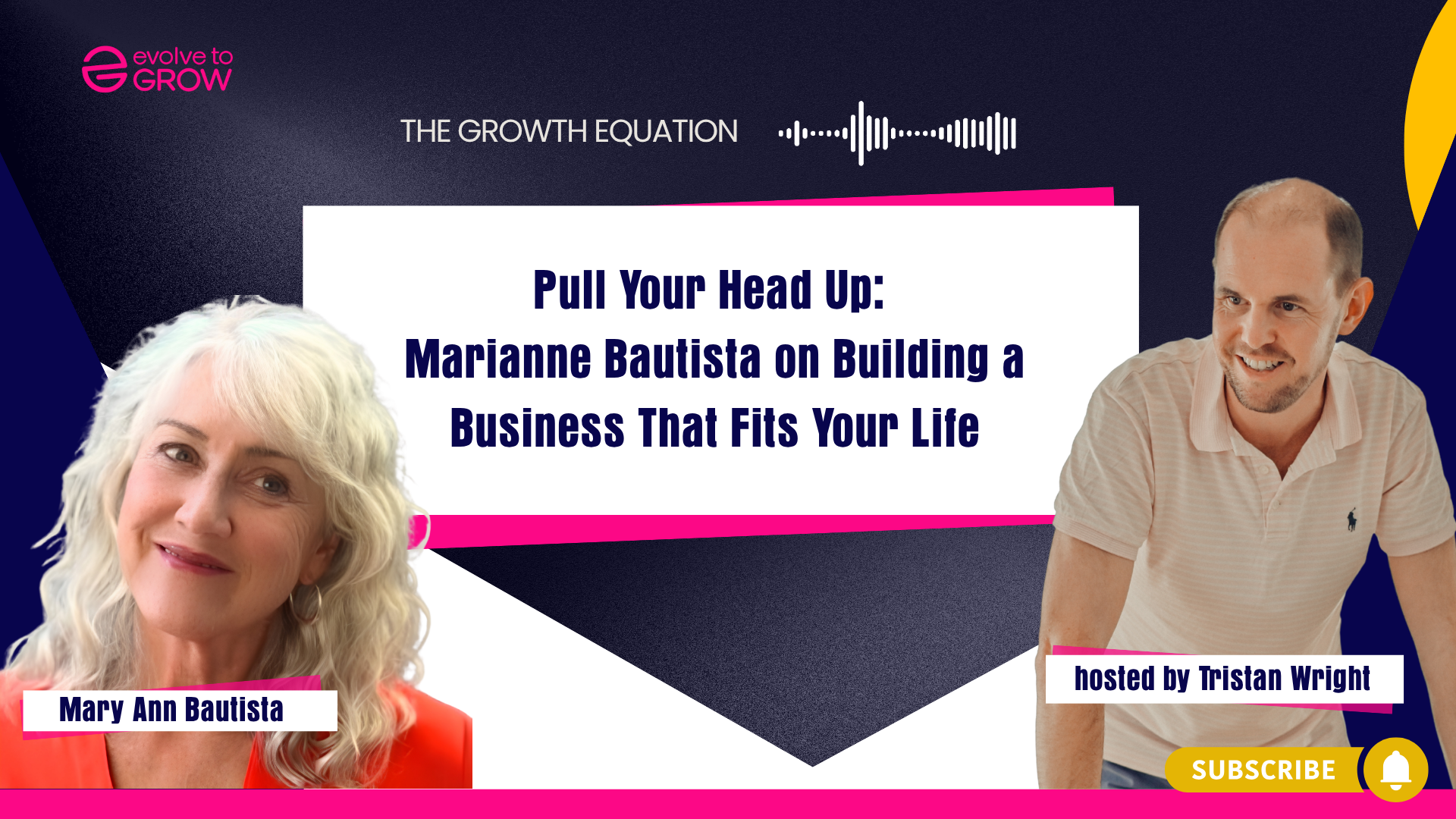
How to Build a Business That Fits Your Life: Lessons From Mary Ann Bautista
Your Business Should Support Your Life, Not Take It Over
Many entrepreneurs start a business because they want more control over their time and their lives.
But somewhere along the way, the business can become the thing controlling everything.
More clients. More responsibilities. More decisions. More problems to solve.
Before long, the founder is working harder than ever and spending less time on the things that motivated them to start the business in the first place.
For Mary Ann Bautista, building a business that fits her life became an important part of her entrepreneurial journey.
Mary Ann began her career in direct response marketing, working for major publishers and businesses before starting her own agency, Bautista Direct Marketing, in 1998.
Years later, she co-founded TurboRank with Matthew Pierce.
The second time around, Mary Ann brought something with her that she didn’t have when she started her first business: experience.
She knew what worked.
She knew what didn’t.
And, perhaps most importantly, she knew the cost of being too deep in the weeds.
Her advice to other business owners is simple:
Pull your head up.
Build the Business Around the Life You Want
Mary Ann’s decision to start her own business wasn’t purely driven by ambition.
She and her husband wanted to have a family, and she wanted to be present for her children.
Entrepreneurship gave her the ability to make that possible.
She could serve her clients while also being available for important moments in her children’s lives.
She describes being able to be “reading mom” on a Thursday afternoon because there wasn’t someone above her telling her she couldn’t.
That freedom was part of the point.
The business wasn’t supposed to become the centre of everything.
It was supposed to enable the life she wanted to live.
This is an important question for any entrepreneur:
What is your business actually for?
The answer isn’t necessarily the same for everyone.
For one founder, it might be building a large company.
For another, it might be creating financial security.
For someone else, it might be having flexibility, spending more time with family, or having the freedom to choose how they spend their days.
There is no single definition of success.
But if you don’t define what you’re building towards, it’s easy to let the business define it for you.
The Problem With Being Too Deep in the Day-to-Day
Mary Ann intentionally kept her first business relatively small. At its height, Bautista Direct Marketing had around ten people.
But she was heavily involved in the daily operations.
She was in the weeds with clients.
She was involved with the media they were buying.
She was deeply involved in the work.
And while that involvement helped her serve the business, it also created a problem.
She didn’t have enough space to step back and see what was happening at a higher level.
Looking back, Mary Ann considers that one of the mistakes she made in her first business.
She hadn’t given her team enough responsibility, and she hadn’t given herself enough room to think strategically.
This is a common challenge for experienced founders.
The work you’re doing is often work you’re very good at.
So why stop doing it?
Because eventually, the founder’s role needs to change.
There is a difference between working in the business and working on the business.
If every important decision, client issue, and operational problem still requires the founder, the business can struggle to grow beyond that person’s capacity.
More importantly, the founder can lose the perspective needed to decide where the business should go next.
Use Your Experience to Build the Second Business Differently
When Mary Ann and Matthew created TurboRank, they didn’t simply repeat the same process.
They started by thinking about what they wanted the business to become.
They reverse-engineered their goals around things such as:
- Number of accounts
- Financial targets
- Profitability
- Number of employees
- Operational structure
Rather than simply hoping the business would grow into something they wanted, they created targets and worked backwards.
That gave them something concrete to measure.
Mary Ann also emphasises the importance of reviewing those goals.
Setting a goal and forgetting about it doesn’t create accountability.
She now checks the business against its goals every month and looks at the indicators that show whether they’re moving in the right direction.
This creates a simple but powerful feedback loop:
Set the goal → measure progress → identify what’s changing → adjust → repeat.
For business owners who naturally operate more creatively, this can be particularly valuable.
Mary Ann describes herself and her business partner as creatives who don’t naturally gravitate towards structure.
But she has learned that structure is necessary.
Interestingly, she came from direct response marketing, where measurement was already central to the work.
The difference was that she was comfortable measuring results for her clients.
Measuring her own business was another story.
That distinction is worth paying attention to.
Business owners need to measure themselves with the same discipline they bring to their clients.
Don’t Confuse More Content With Better Content
Mary Ann’s experience in marketing has also given her an interesting perspective on how businesses should approach content.
TurboRank works heavily with YouTube and what Mary Ann describes as an authority-building strategy.
But the goal isn’t simply to produce more videos.
The strategy starts with understanding what people are actually asking.
What questions are coming from the search bar?
What does the audience want to understand?
What information do they need before they’re ready to make a decision?
Without that understanding, a business can spend a huge amount of time producing content that nobody is looking for.
Mary Ann describes this as one of the biggest mistakes she sees businesses make:
They create content first and figure out the strategy afterwards.
A stronger approach is to understand demand first and then build the content strategy around it.
That means identifying the questions, developing content pillars, establishing a cadence, and creating content that answers real problems.
The principle applies beyond YouTube.
Before creating another piece of content, ask:
What question is this actually answering?
AI Is Changing How People Find Businesses
The way people search for information is changing.
Mary Ann has seen the impact firsthand through her work with websites and YouTube.
As AI and large language models have become part of the way people discover information, businesses have had to rethink where their authority comes from.
Instead of relying entirely on traffic to their own websites, TurboRank focuses on building a broader authority footprint.
That can include platforms and communities where relevant conversations are already happening, alongside YouTube and other forms of content.
The goal is to create a body of credible information that can be discovered across multiple sources.
This represents a shift in how businesses should think about digital marketing.
It’s not simply:
“How do I get more traffic to my website?”
It becomes:
“How do I build enough authority and credibility that people—and the systems helping people find information—recognise my brand as a useful source?”
That requires more than publishing content.
It requires understanding the audience, answering meaningful questions, and consistently demonstrating expertise.
Build Authority Instead of Just Renting Attention
Mary Ann also makes an important distinction between paid media and organic marketing.
Paid media can be extremely effective.
When you turn the advertising “faucet” on, traffic and sales can follow.
But when the spend stops, the attention largely stops with it.
Organic authority works differently.
It can take longer to build, but the content and credibility you’ve created can continue generating value over time.
That’s why Mary Ann sees authority building as an asset.
You’re not simply paying for someone’s attention.
You’re building something that can compound.
For businesses with complex products or services—especially those that require customers to research, compare, and ask questions—that long-term authority can become particularly valuable.
The challenge is that organic growth requires patience.
It’s not always immediate.
But the objective is to build something that continues to work rather than something that disappears the moment the budget is turned off.
Choose Business Partners Carefully—and Define the Rules Early
Building a business with a partner creates another set of challenges.
Both Mary Ann and Matthew had previously run their own businesses, which meant they each brought their own experience and ways of working to TurboRank.
They addressed this early by creating a detailed partnership agreement.
They spent significant time thinking through responsibilities, decision-making, expectations, and what would happen if something unexpected occurred.
That included uncomfortable scenarios that many business partners might prefer not to discuss.
But having those conversations upfront created clarity.
Over time, Mary Ann says, the relationship has developed into deep trust and respect.
The lesson isn’t that a partnership agreement eliminates problems.
It’s that clear expectations give partners something to fall back on when problems arise.
A strong business partnership isn’t just about getting along.
It’s about agreeing on how the business will actually work.
Make Time to Step Back and Look Around
When Tristan asks Mary Ann for one piece of advice she would give other business owners, she doesn’t talk about a marketing tactic, a technology, or a growth strategy.
She goes back to the lesson that shaped her second business.
Pull your head up above the fray and look around.
It’s easy to spend every day reacting.
A client needs something.
A team member has a problem.
A deadline is approaching.
Sales need attention.
Something needs fixing.
There’s always another task.
But if you’re constantly reacting, when do you actually think?
When do you assess whether the business is heading in the right direction?
When do you look at the numbers?
When do you notice changes in the market?
When do you ask whether the business still fits the life you wanted it to create?
Stepping back isn’t avoiding work.
Sometimes, it’s the most important work you can do.
Build a Business That Fits Your Definition of Success
Mary Ann’s story isn’t about creating a perfect business.
Her first business taught her lessons that she carried into her second.
She learned what happens when a founder becomes too involved in the day-to-day.
She learned that goals need to be measured.
She learned that structure can support creativity rather than restrict it.
She learned that partnerships benefit from clear expectations.
And she learned that building a business around your life requires intentional decisions.
Most importantly, she learned to create space to see the bigger picture.
Because business growth isn’t necessarily about doing more.
Sometimes it’s about getting clear on what you’re building, why you’re building it, and whether the way you’re operating is actually taking you there.
So before you dive into the next task, solve the next problem, or add another item to your list, take Mary Ann’s advice:
Pull your head up. Look around.
You might see something you’ve been too busy to notice.
Connect With Mary Ann Bautista
Mary Ann Bautista is the co-founder of TurboRank, a company focused on YouTube strategy, organic marketing, and building authority for businesses with complex products and services.
You can connect with Mary Ann on LinkedIn or reach out to TurboRank directly.
Email: hello@turborank.co
Website: TurboRank.co
YouTube: TurboRank
Listen to the Full Episode
Want to hear Mary Ann’s full story and learn more about building a business that fits your life?
Listen to Episode 80 of The Growth Equation:
Pull Your Head Up: Mary Ann Bautista on Building a Business That Fits Your Life
Subscribe to The Growth Equation for more conversations with entrepreneurs and business owners about building businesses that support sustainable growth—and the lives behind them.